
Checking Criminal History in Douglas County
No single Douglas County search contains the police narrative, jail cycle, filed court charges, and statewide fingerprint history. Begin with the question the record must answer. The free DCSO Jail Viewer is suited to recent bookings. Oregon's basic case search or the two free terminals in Circuit Court Room 201 show filed cases. An agency report comes from the department whose case number appears on the citation or booking detail.
Gather the full name, likely spelling variants, approximate event date, and any booking, agency, or court case number. Date of birth helps OSP distinguish people, but it is not a Jail Viewer field. A percent sign works as a wildcard in jail name searches. Match identifiers across sources before treating two entries as the same person.
- Search recent custody in Jail Viewer by name, dates, or status, using
%for an uncertain spelling. - Write down the booking number, arrest agency, agency case number, and original charge rather than relying on the result caption.
- Search Oregon court data for the filed case, then check the correct Circuit, justice, or municipal court.
- Request the underlying report from DCSO or the city police agency that created it.
- For an authoritative self-review, compare the court result with a fingerprint-based OSP Copy of Own Record.
Douglas County Record Custodians
The Douglas County Justice Building concentrates several justice offices at 1036 SE Douglas Avenue in Roseburg, but a shared address does not create a shared file system. Circuit Court records are state court records in Room 201. DCSO report requests go to JB Room 320. Community Corrections works from JB206, while the jail and Sheriff's Office occupy the same complex. A request addressed only to “the courthouse” can reach the wrong custodian.
Douglas County Circuit Court
Room 201, 1036 SE Douglas Avenue, Roseburg, OR 97470
541-957-2471
Case files, judgments, copies, and two free public terminals.
DCSO Records
JB Room 320, 1036 SE Douglas Avenue, Roseburg, OR 97470
541-440-4463
Sheriff reports, logs, local history products, and dispatch records.
Community Corrections
JB206, 1036 SE Douglas Avenue, Roseburg, OR 97470
541-957-8148
Weekdays, 8:00 a.m. to 5:00 p.m.
The county officials directory identifies the current offices responsible for this system.
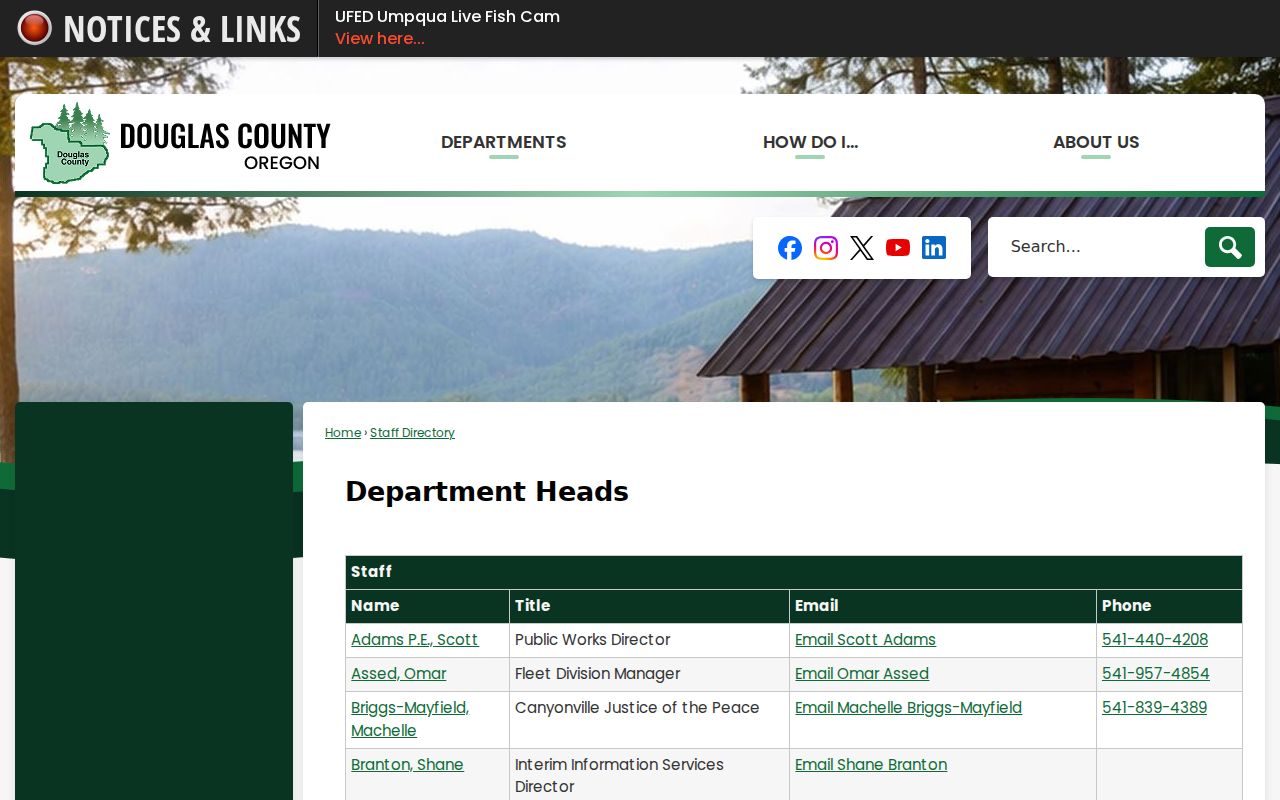
That directory is the better place to recheck an office holder or department contact before sending a time-sensitive request.
Oregon Official Background Checks
Oregon State Police CJIS maintains the Computerized Criminal History repository. For a review of one's own Oregon record, the official route is a fingerprint-based Copy of Own Record. The requester sends a fresh FBI FD-258 card, OSP form, and $33 to CJIS. Results go only to that requester. Existing applicant or criminal prints cannot be reused, and the result covers Oregon rather than every state or FBI record.
A name-based request about another person uses the OSP Open Records Portal and costs $33. It discloses Oregon convictions plus arrests less than one year old when no dismissal or acquittal has been reported. OSP gives the subject a 14-day chance to challenge the result. A “no record” response is not proof that no police contact ever occurred.
| Product | Identity method | Scope and fee |
|---|---|---|
| Copy of Own Record | Fresh fingerprint card and form | Subject's Oregon CCH, $33 |
| Open Record | Name, birth date, address, requester details | Limited public Oregon history, $33 |
| FBI Identity History Summary | Subject fingerprints | FBI-maintained national history, $18 direct |
The OSP criminal-history products page shows the current forms and product boundaries.
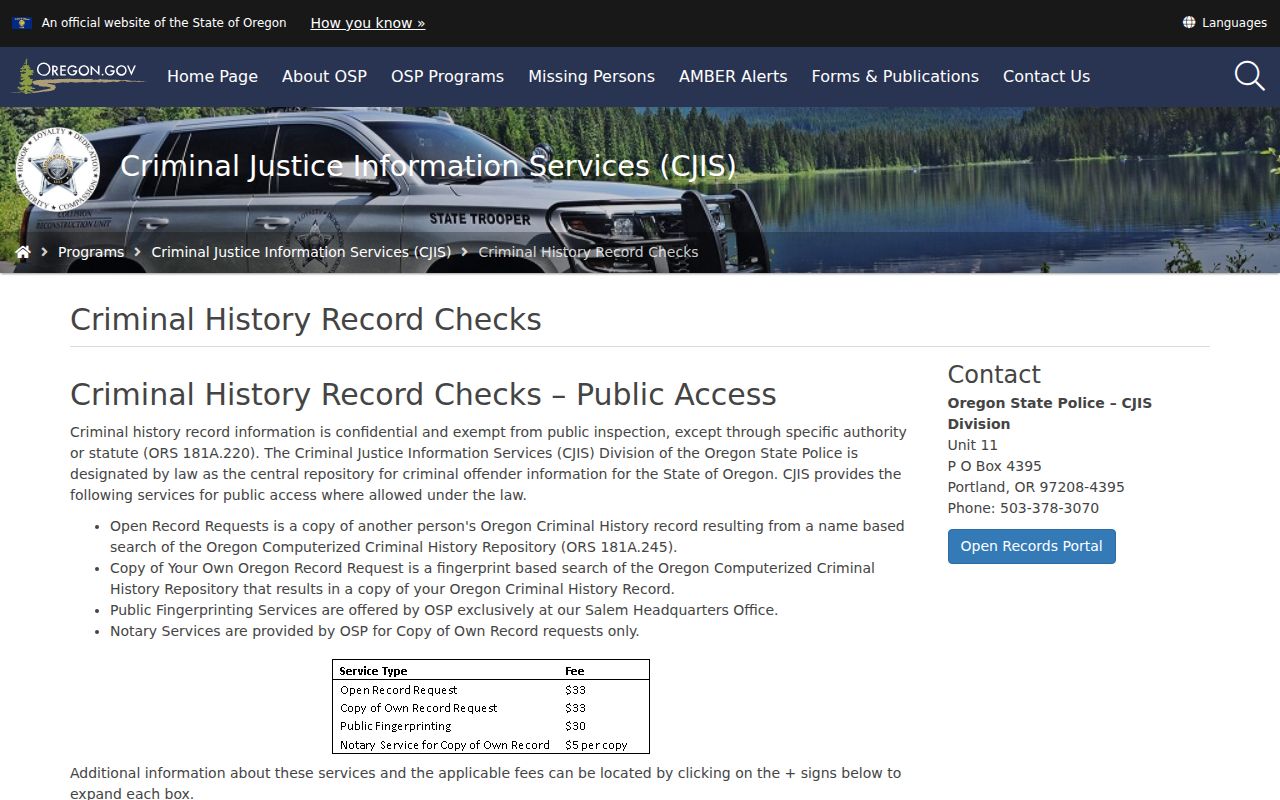
The official product page should be checked again before mailing because forms, counter service, and fees can change.
Douglas County Jail Viewer Fields
The browser-based DCSO Jail Viewer is Douglas County's public booking tool. It accepts one field or a combination, so a broad last-name search can be narrowed with booking dates or custody status. The percent sign works anywhere as a wildcard, such as M% or sm%th. No verified DCSO mobile app offers a separate records search.
| Search field | Best use | Caution |
|---|---|---|
| Last and first name | Find a known person or spelling pattern | Names can match more than one person |
| Booking date range | Limit a recent intake search | Booking date is not offense date |
| Release date range | Find a completed jail cycle | Release does not mean dismissal |
| Status | Separate in-custody and released entries | Transfer may end local custody display |
A detail can show booking and inmate IDs, dates, physical descriptors, status, charges, arrest agency, and agency case number. These are intake data. The Douglas County arrest lookup explains how to trace them to the report and disposition.
Criminal Record Types
Record type determines the custodian. DCSO or a city police agency writes the incident report. The jail creates a booking entry only when a person is lodged. Oregon Circuit Court, justice courts, and municipal courts maintain filed cases within their authority. OSP combines qualifying fingerprint arrest cycles with later reported dispositions in the statewide CCH.
Warrant, supervision, and registry information follow other routes. Courts issue warrants; law enforcement tracks service. Douglas County Community Corrections holds supervision files, while ODOC provides public custody status. OSP operates the public sex offender registry, but only the statutorily disclosed subset appears online.
- Incident and arrest report: the creating police agency's account of the event and officer action.
- Booking record: DCSO intake, custody dates, identifiers, and original detention charges.
- Court case file: filed counts, motions, events, pleas, judgment, sentence, and financial entries.
- CCH or rap sheet: OSP's fingerprint-indexed Oregon history, with public and subject-only products of different scope.
- Custody, supervision, and registry records: records maintained by DCSO, ODOC, Community Corrections, OSP, and related authorities.
Douglas County Search Channel Comparison
The three most common searches answer different questions. Jail Viewer shows a local custody cycle. OJCIN and the court's official file show prosecution. OSP CCH connects qualifying fingerprint events with dispositions reported to the repository. Comparing them is more reliable than stretching one source beyond its purpose.
| Channel | Best answer | What it does not prove |
|---|---|---|
| DCSO Jail Viewer | Was this person booked or held locally? | Guilt, filed charge, or final result |
| OJD basic search or OJCIN | What was filed and how did the case move? | Every police narrative or a full rap sheet |
| OSP CCH | What qualifying Oregon history is tied to identity? | The complete pleading and document file |
Inside a Douglas County Criminal Record
The contents change with the source. An Oregon CCH is organized around identity and fingerprint-linked arrest cycles. A court file adds a chronological Register of Actions, documents, hearings, financial obligations, and judgments. Jail Viewer adds booking and custody fields. Compare each charge separately because one count may be amended while another is dismissed or results in conviction.
| Name & Identifiers | Legal name, aliases, date-of-birth data where public, fingerprint identifiers in CCH, booking or case number. |
|---|---|
| Arrest / Booking Data | Arrest agency, date, agency case, intake and release dates, custody status, and original charge. |
| Charges & Statutes | Each alleged or filed count, Oregon statute, offense class, and later amendments. |
| Disposition | Dismissal, acquittal, conviction, or other outcome for each count rather than one case-wide label. |
| Sentence | Custody, probation, restitution, fines, and other terms recorded in the judgment. |
| Custody / Supervision Status | Local jail status, ODOC status, or court-ordered supervision, subject to public-access limits. |
Douglas County Sheriff Request Costs
A DCSO report request can be emailed to dcsoinfo@douglascountyor.gov or sent to JB Room 320. The form asks for the people involved, birth date if known, event time and location, case number, and exact product. Checkboxes separate a police report, log entry, local criminal-history product, dispatch log, 911 or non-emergency audio, and law or fire radio traffic.
| Face sheet or one page | $5 |
|---|---|
| Report through six pages | $8 |
| Additional pages | $0.25 each |
| Photos | $15 |
| Staff processing | $25 per hour, billed in 15-minute units |
| Research deposit | $10 |
| Dispatch audio | $30 first hour, then $25 per hour in 15-minute units |
The stated three-day minimum is not a completion promise. Staff may require a deposit or full estimate, and charges can apply even if no responsive public record is found. The local form states that body-worn-camera video requires a subpoena, so readers should not assume the ordinary copy schedule applies.
Public Access Laws in Oregon
Oregon Public Records Law provides access to nonexempt government records, but it does not make every criminal-history detail public. The request goes to the office that holds the original. An agency may redact juvenile, victim, medical, security, personal-identifier, and active-investigation information. It may charge actual staff and copy costs and need not create a new explanation in response.
Key Statutes:
ORS 192.311-192.478 - establishes Oregon's public-record request and response framework.
ORS 181A.220 and 181A.245 - protect criminal-history information while authorizing the limited Open Record process.
ORS 7.095 and UTCR 2.100 - govern court record and electronic access subject to protection rules.
ORS 137.225 - permits qualifying adult arrest, dismissal, and conviction records to be set aside and sealed.
ORS Chapter 163A - controls sex offender reporting, classification, and public disclosure.
Douglas County Supervision Records
Douglas County Community Corrections supervises more than 1,000 adults on felony or certain misdemeanor probation, parole, and post-prison supervision under ODOC standards. It does not publish a general probation roster. A court judgment is the source for a probation sentence, while Oregon Offender Search can show qualifying public ODOC status. Treatment, victim, risk-assessment, and officer-safety material may remain confidential.
The ODOC Douglas Community Corrections profile confirms the local office and state-county partnership.
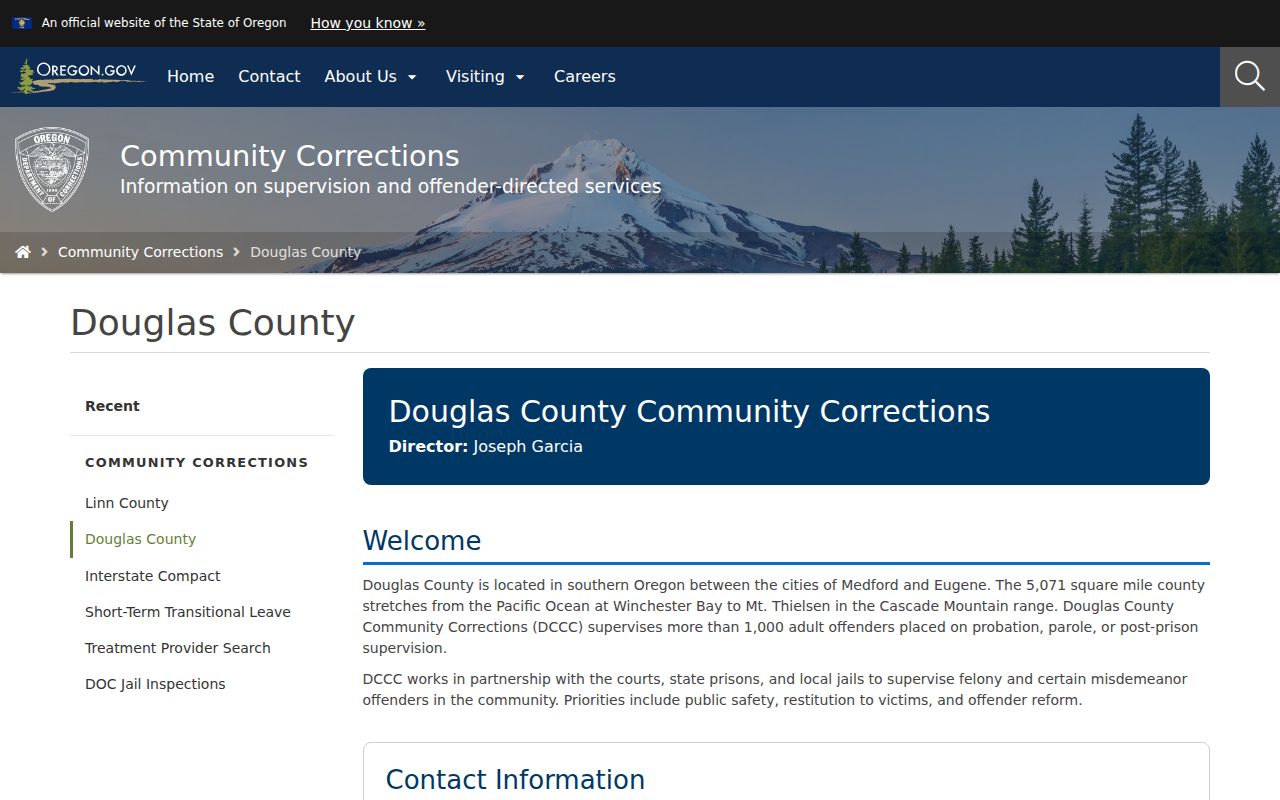
This route helps distinguish a sentence of community supervision from current prison or county-jail custody.
Sealed, Expunged, and Restricted Records
Oregon calls its main adult clearing procedure a “set aside.” Under ORS 137.225, a qualifying order seals eligible arrest, dismissal, conviction, or contempt records. It does not turn the result into an acquittal. Eligibility depends on the current statute, completion of the whole sentence, offense limits, and waiting rules. The motion and proposed order go to Douglas Circuit Court, with required materials also served on the Douglas County District Attorney.
Juvenile files follow separate confidentiality rules. People outside the listed parties and agencies may need a motion, sworn declaration, service, and good-cause order under ORS 419A.255. After an adult set-aside order, verify the court search and one's fingerprint-based OSP record. If the item still appears, send the order through the source court or agency and OSP correction process.
Douglas County Custody Transfers
A person may leave the Douglas Jail Viewer after transfer without leaving the correctional system. The county jail houses pretrial adults, short local sentences, and people awaiting ODOC movement. Once state custody begins, use Oregon Offender Search and VISOR rather than assuming a missing local status means release into the community.
The official Oregon Offender Search gateway connects readers to state custody and notification tools.
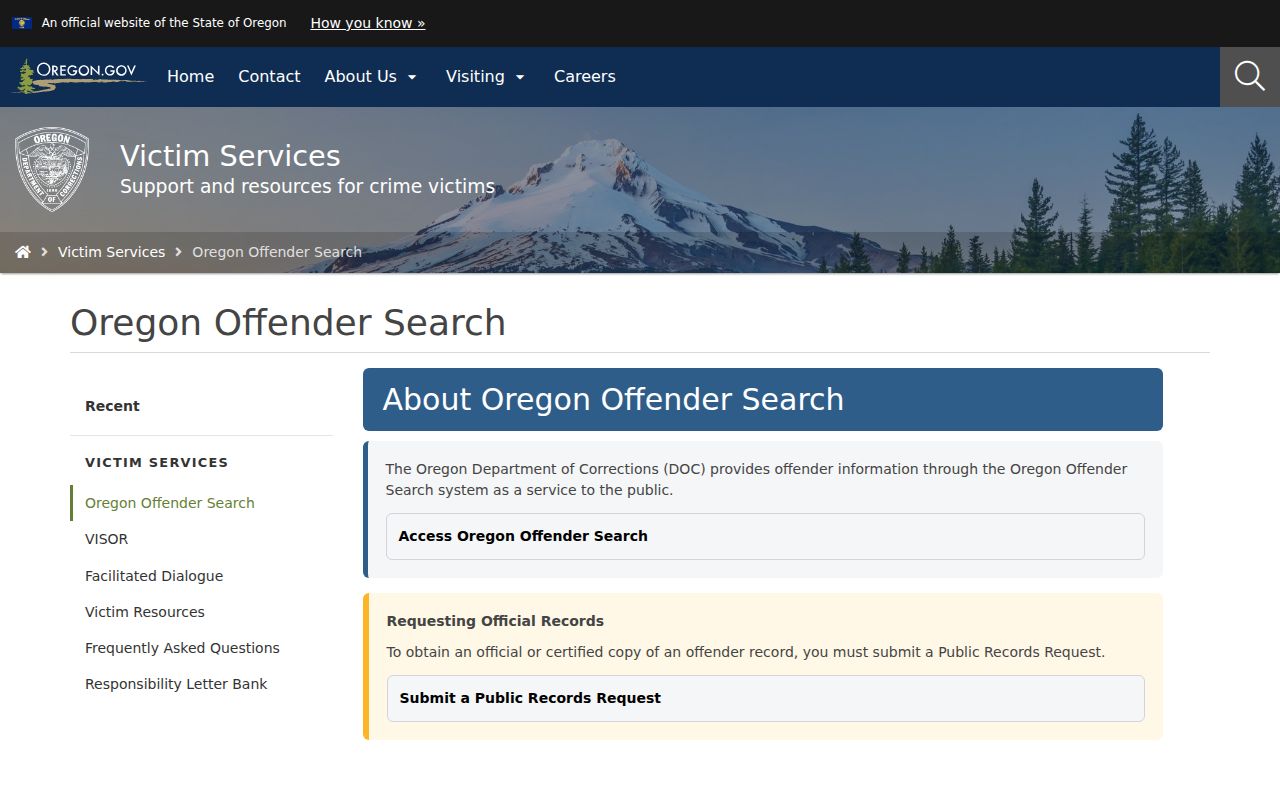
Use the exact jail name and booking identifier to bridge the local record to a later state result.
Douglas County Jail by the Numbers
A 2026 county procurement describes 232 physical beds, 168 beds in service, an operational ceiling near 150 adults, and an average daily population near 125. It also reports roughly 4,000 bookings per year. Those figures describe capacity and intake work, not 4,000 different people and not 4,000 convictions. Repeat bookings and cases that never produce a conviction make that distinction essential.
The jail also serves as a transfer point for southern and coastal Oregon. That role helps explain why a person can appear briefly in Douglas County custody and later require an ODOC search. Physical beds, staffed beds, operational population, and daily population are four different measures; quoting only the largest number would overstate usable capacity.
Douglas County Warrant Checks
DCSO has no verified comprehensive public warrant database. Start with the issuing court instead. Circuit warrants connect to Circuit cases; municipal bench warrants may sit in Roseburg, Sutherlin, or Winston court systems; Reedsport and South Douglas Justice Courts keep their own matters. Search the case, then call the verified clerk or DCSO number to confirm current status.
A warrant can be active, sealed, recalled, or slow to clear from a secondary display. Anyone resolving a possible warrant should obtain the case number and current court direction rather than rely on a commercial people search. Active enforcement questions belong to law enforcement, while appearance and scheduling questions go to the issuing court.
The court name matters as much as the person's name. A municipal clerk cannot confirm a Circuit warrant, and the county's general public-record queue does not replace either clerk. Keep the issue date and charge beside the case number when asking for verification.
Douglas County Criminal Records by City
Roseburg, Sutherlin, and Winston are Douglas County's three largest incorporated cities in the research's current population ranking. Each police department retains its own reports, while lodged adults enter the county Jail Viewer. Municipal courts handle their authorized local dockets; felonies and other state cases route to Douglas Circuit Court. The city named on a citation or arrest-agency line determines the first records counter.
Roseburg Criminal Records
County seat and justice hub · Separate Roseburg police request and municipal court channels.
Sutherlin Criminal Records
Second-largest incorporated city · City police report, county booking, and municipal or Circuit case.
Winston Criminal Records
Local court at 201 NW Douglas Boulevard · Fixed Tuesday dockets and written motion rules.
The Winston Municipal Court page provides the city's unusually specific calendar and filing directions.
Its fixed session times show why a city citation should be read before a search is sent to Douglas Circuit Court.